The Short Answer
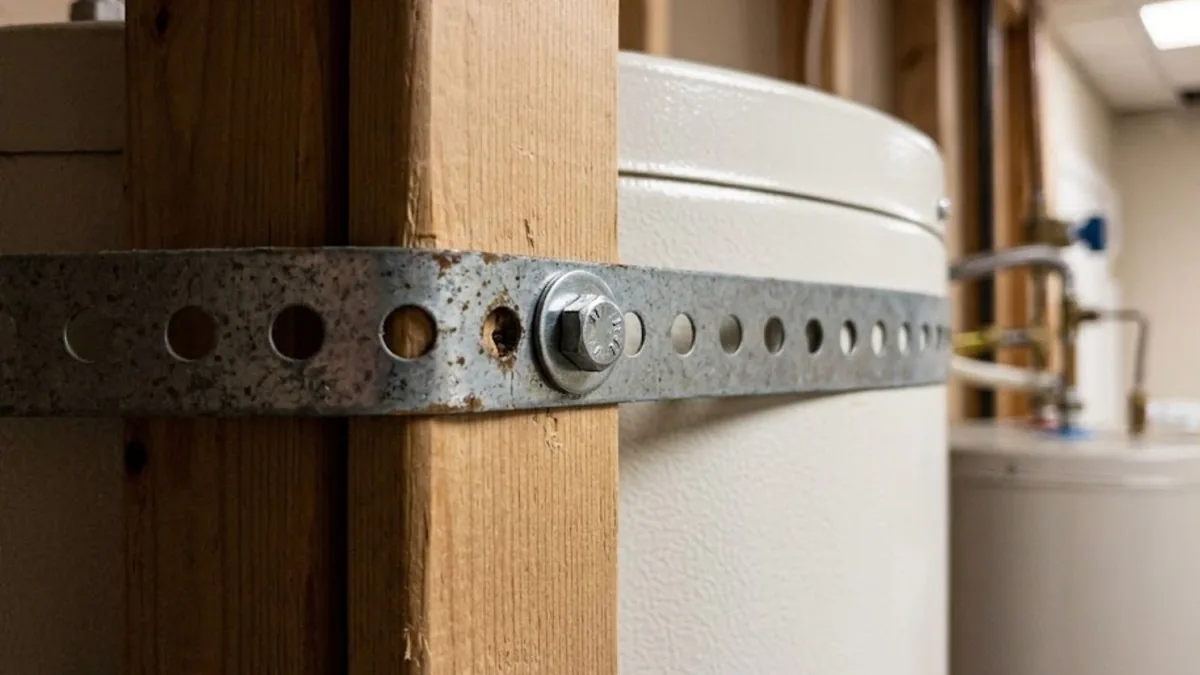
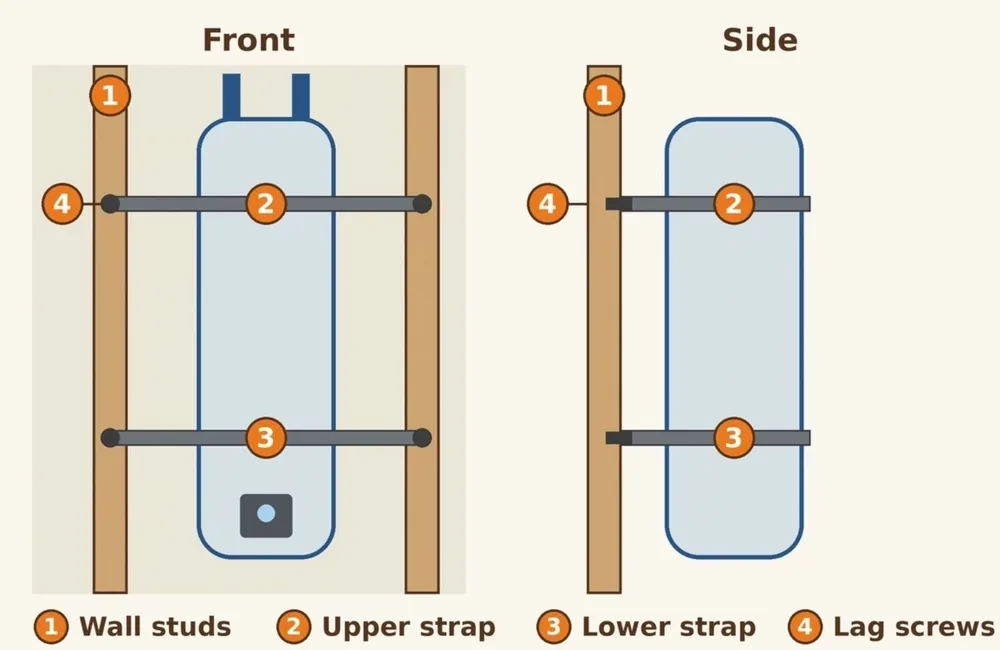
To strap a water heater to California code, fasten two metal straps around the tank, one in the upper third and one in the lower third. The lower strap should sit at least four inches above the controls. Anchor each strap into a wall stud or masonry with lag screws or masonry anchors so the tank cannot tip or slide.
State law applies this to every residential tank-type heater in California, new or old. A full 40-gallon tank holds roughly 330 pounds of water alone, so an unsecured heater can rip out its own gas, water, and electrical connections when the ground moves.
Why California Requires It
Health and Safety Code 19211 says all new and replacement water heaters, and all existing residential water heaters, must be braced, anchored, or strapped against falling or horizontal movement from earthquake motion. At a minimum, the work must meet the California Plumbing Code, which is based on the Uniform Plumbing Code (UPC).
The requirement grew in steps. Bracing became mandatory for new and replacement units sold after July 1, 1991. A 1995 law extended it to existing heaters and added a seller certification at property sales.
Whittier knows the reason better than most places. The magnitude 5.9 Whittier Narrows earthquake on October 1, 1987 hit Uptown Whittier hardest, and the Southern California Earthquake Data Center lists eight deaths and about $358 million in damage across the region. A toppled heater turns a shaken house into a fire or flood risk, which is why the law targets it.
What You Need Before You Start
| Item | What it does | Notes |
|---|---|---|
| Pre-engineered strapping kit | Supplies metal straps, screws, and hardware sized for a standard tank. | The statute covers tanks up to 120 gallons that a kit can fit. |
| Stud finder | Locates solid wood framing behind the drywall. | Hollow drywall anchors do not hold a heater. |
| Drill and driver | Sets the lag screws into the studs. | Pilot holes keep the wood from splitting. |
| Level and tape measure | Marks the upper and lower strap heights. | Measure from the tank, not the floor. |
| Helper | Keeps the tank steady while you work. | Never lean on a full tank. |
Step By Step: Strapping A Standard Tank
Follow the instructions in your kit if they differ from the general steps below. Kits are made to meet the code for their tank size.
- Remove any insulating blanket first. A blanket compresses and lets the straps loosen over time.
- Mark the upper third and lower third of the tank. Place the lower strap at least four inches above the controls so it never blocks the gas valve or thermostat.
- Find the wall studs behind the heater. The straps must reach solid framing or masonry.
- Wrap the first strap around the tank, run both ends to the wall, and drive lag screws through the strap holes into the studs.
- Repeat for the second strap, then pull both snug. The tank should not rock, rotate, or lift away from the wall.
- Check that the straps do not touch the relief valve, discharge pipe, flue, or any wiring, and that the controls and access panels are clear.
Common Mistakes Inspectors Notice
Straps over an insulation blanket
The blanket can slide or compress, and the straps stop holding the tank itself.
Only one strap
A single strap lets the tank swing around its pivot. The code expects two.
Hollow wall anchors
Plastic anchors in drywall pull out under load. The screws must reach framing or masonry.
Straps covering the controls
A strap across the gas control or thermostat blocks service and fails the check.
Tankless, Large Tanks, And Special Cases
The statute defines a water heater as a standard unit of no more than 120 gallons for which a pre-engineered strapping kit is readily available. Wall-mounted tankless units do not store water and are generally exempt from the strapping rule, though they still need a solid mount.
Larger tanks, such as 50 gallons and up, often benefit from extra attachment points, and a heater on a platform or in a tight closet may need a plumber's judgment. Do not improvise with plumber's tape on a heavy tank when a proper kit exists.
Not Sure Your Heater Is Secure?
Call and ask for a quick bracing check while a technician is on site.
When To Call A Plumber Instead
Strapping is a reasonable weekend job for a handy owner, but several situations call for a professional. A heater near a gas line, in a cramped closet, or on a platform has more at stake if a strap fails. Corroded fittings, a leaking tank, or a flue that is not clearly secure are all reasons to stop.
If the tank is more than about ten years old, bracing it is still correct, but it may also be time to look at water heater installation and replacement. A new unit gets braced, permitted, and tested as part of the job. If your heater is misbehaving rather than old, gas and electric heater repair can include a look at the straps while the panel is open.
Homes on the slopes of the Puente Hills, such as those in Hacienda Heights, often have heaters in garages with long gas and water runs. Those installs deserve an extra look at flexible connectors as well as the straps.
Water Heater Strapping Questions
Yes. Health and Safety Code 19211 requires new, replacement, and existing residential tank-type water heaters to be braced, anchored, or strapped against earthquake motion.
Two at minimum: one in the upper third and one in the lower third of the tank, with the lower strap at least four inches above the controls. Larger tanks may need more attachment points.
Wall-mounted tankless units do not hold a stored tank of water and are generally exempt from the strapping rule. They still need a secure mount and proper connections.
The statute requires the seller to certify to the buyer that the heater has been secured. A heater that is not strapped can complicate a sale, so fix it before listing.
Many owners do, using a pre-engineered kit that meets the code. Hire a plumber if the heater is near a gas line, in a tight space, or if the fittings look worn.
Permit rules for adding straps vary by city, so ask your building department. Replacing the heater does need a permit, and the inspection normally checks the bracing.
Secure The Tank, Sleep Better
Call to have a technician check your water heater straps.
Call (562) 488-9614