The Short Answer
A sewer lateral is the pipe that carries wastewater from a building to the public sewer main in the street. In most California communities, the property owner is responsible for it, and the city or sanitation agency is responsible for the main. But the exact dividing line varies, and California has no statewide program that sets it.
The State Water Resources Control Board regulates sewer systems and requires local agencies to maintain public mains. It does not mandate who owns the private lateral. That is why you must check your own city's rules before you assume a backup is not your bill.
How Different Agencies Draw The Line
| Agency | Owner's side | Agency's side |
|---|---|---|
| City of Torrance | The owner maintains the lateral, including the point of connection to the main. | The public sewer main. |
| Union Sanitary District | The owner maintains and repairs the lateral up to the connection with the public main. | The public main, which the district inspects for free if you call. |
| Suisun City (Fairfield-Suisun Sewer District area) | The homeowner is responsible for the lateral and a private cleanout. | The city is responsible for the lower lateral from a city-approved cleanout to the main. |
| City of Santa Ana | Owners have historically built and maintained laterals serving their property. | The public main. A 2015 council item took up an ordinance defining lateral ownership. |
Upper And Lower Lateral
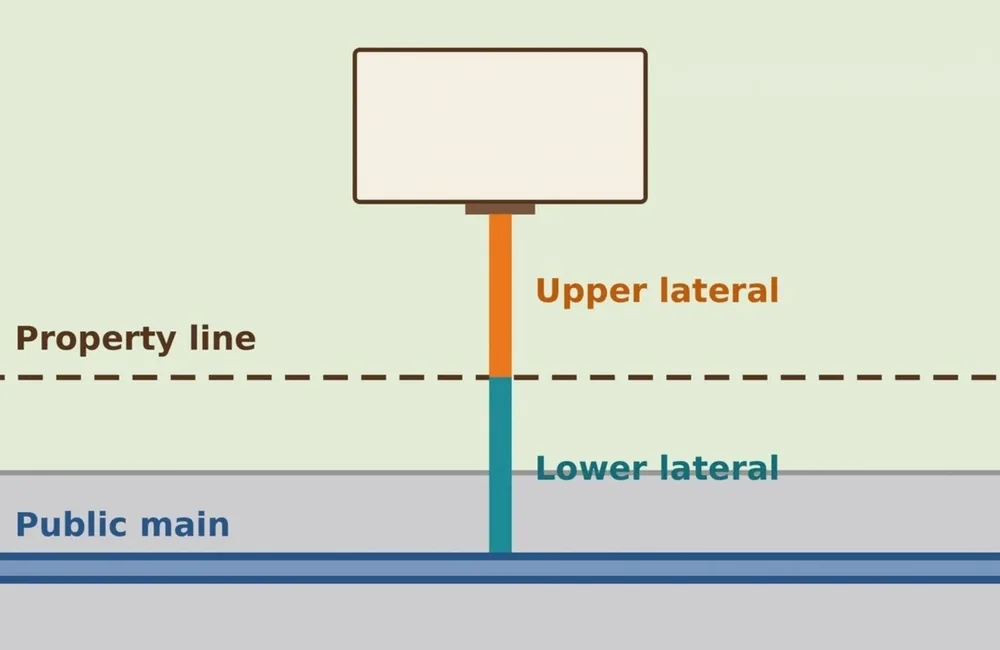
Many agencies split the lateral into two parts. The upper lateral runs from the building to the property line, and the lower lateral runs from the property line to the main. Some cities treat the whole pipe as the owner's, while others take over the lower portion.
Work in the street or the public right of way also needs permission. Agencies commonly require an encroachment permit when a repair means digging in the public right of way, even where the pipe belongs to the owner. Ask who applies for it before the trench opens.
Why does the boundary matter so much? Because it decides who pays and who hires. If the failure sits in the lower lateral or the main, the agency may fix it at no charge to you. If it sits on your side, you hire the contractor and carry the cost.
A camera video that shows the exact location, measured from the cleanout, is the evidence that settles most disputes. Ask the plumber for a copy of the footage and the measurement in writing before you pay. Slope, cleanout access, and pipe material for a new lateral follow the California Plumbing Code, which is based on the Uniform Plumbing Code (UPC).
Questions To Ask Your City Or Sanitation Agency
Call public works or check the agency's website. These questions settle most cases.
- Where does my responsibility for the lateral end, at the property line, the cleanout, or the main?
- Does the city or district maintain the lower lateral, and does it need an approved cleanout first?
- Can the agency inspect the public main when I have a backup, and is there a charge?
- What permits do I need for lateral repair or replacement, including any encroachment permit?
- Does the agency offer a rebate or cost-sharing program for lateral replacement?
Backup And Not Sure Whose It Is?
Call. A camera inspection shows where the problem sits and who has to fix it.
Why A Camera Settles The Question
When a backup occurs, it is often unclear whether the blockage is in your lateral or in the public main. A camera run from your cleanout shows the pipe, the blockage, and the distance from the cleanout. That distance matters, because it tells you whether the problem is on your side of the property line.
Some agencies will inspect or clear the public main if a licensed plumber's video shows the blockage is there. Keep the footage, since it supports any request for help. In older neighborhoods with clay laterals, roots at the joints are a common cause, and the camera shows them clearly.
What To Do When A Sewer Backs Up
Stop
Stop using water and keep people and pets away from affected areas.
Document
Photograph the backup and note the time and drains involved.
Inspect
Get a camera look from the cleanout to find the blockage.
Contact
If the problem is in the main, call the city or sanitation agency.
What This Means In The Whittier Area
Most Whittier-area homes date to the 1950s, so their laterals are decades old and often clay. Ask Whittier's public works department or your city's sanitation office about the owner-versus-city boundary at your address. Homes in unincorporated areas generally follow county rules instead of a city's.
A camera inspection is the first step in lateral repair, and when the pipe cannot be saved, sewer lateral replacement covers trenchless and open-trench methods. For recurring clogs short of failure, high-pressure jetting can restore flow.
Orange County cities such as La Habra set their own rules, so the answer for a La Habra address can differ from one a few streets away in Los Angeles County.
Signs Your Lateral May Be Failing
A lateral rarely fails without warning. These signs show up first, and they matter because the repair is usually the owner's.
Repeat slow drains
If a plumber clears the line and it slows again within weeks, the cause is probably structural.
Gurgling from fixtures
Air pushed back by a restriction can bubble up through tubs and toilets.
Sewer odor outside
A smell near the cleanout or a patch of unusually green, soggy ground can point to a leak.
Backups in the lowest drain
Wastewater rising in a ground-level tub or floor drain points to a restriction downstream.
Sewer Lateral Questions
Usually yes for the part on your property, and in many places for the whole lateral up to the main. Check with your city or sanitation agency for the exact boundary.
No. The state requires local agencies to maintain public mains but does not mandate who is responsible for private laterals.
The upper lateral runs from the building to the property line. The lower lateral runs from the property line to the main in the street.
Some agencies offer rebates or cost-sharing. Ask yours, and ask before work begins because programs often require pre-approval.
Generally yes, and work in the public right of way may also need an encroachment permit. Ask who applies for each.
Call a plumber for a camera inspection from your cleanout. If the blockage is in the public main, contact your city or sanitation agency.