The Short Answer
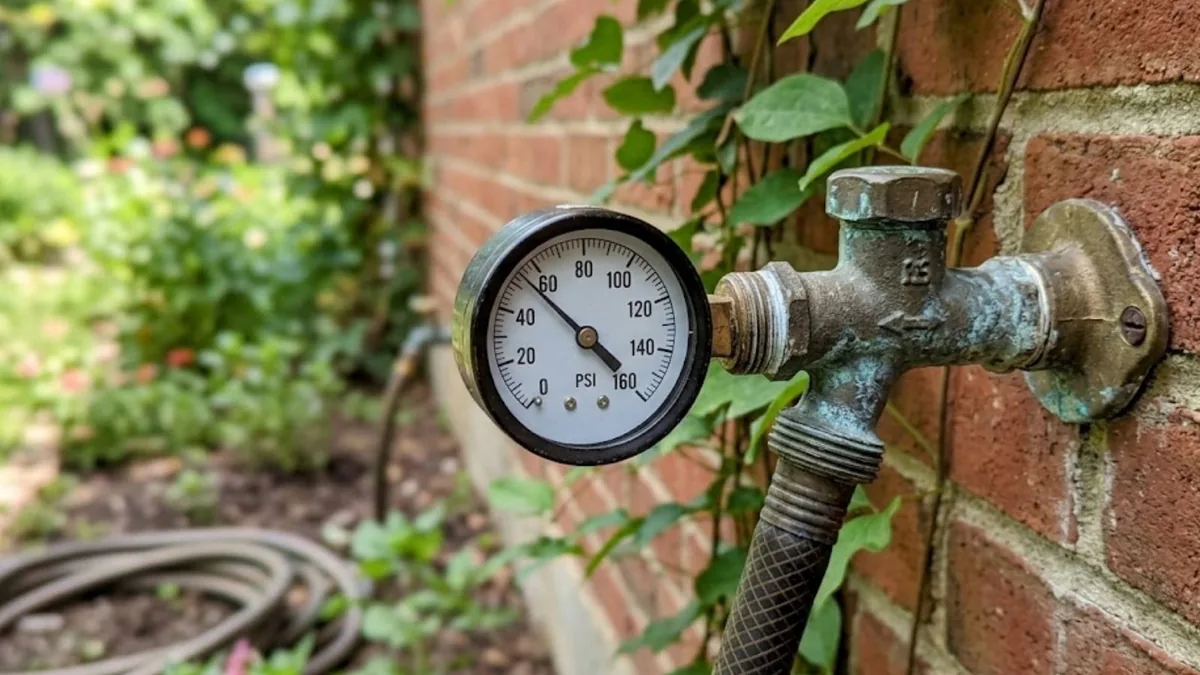
Measure first. Screw a pressure gauge onto an outdoor hose bib, close every other tap, and read the dial. Many homes run comfortably between about 40 and 80 psi. The plumbing code calls for a pressure regulator when street pressure exceeds 80 psi, so a reading above that points to a missing or failing regulator.
A low reading usually means a partly closed valve, a clogged line, a failing regulator, or a leak. A high reading usually means a regulator that has failed or was never installed. Which one you have decides the fix.
How To Measure Your Pressure
A hose-bib gauge costs little and takes five minutes.
- Buy a water pressure test gauge with a threaded hose connection.
- Turn off all water use in the house, including the ice maker, dishwasher, and irrigation.
- Screw the gauge onto an outdoor hose bib and open the bib fully.
- Read the dial and note the time. Pressure often changes through the day.
- Take readings in the morning, at midday, and in the evening. A large swing points to a supply problem and not a household one.
Symptoms And What They Often Mean
| What you notice | Likely pressure issue | Common cause |
|---|---|---|
| Weak flow at every fixture | Low pressure. | Partly closed main or meter valve, failing regulator, or a restricted line. |
| Weak flow at one fixture | Local restriction. | Clogged aerator or showerhead, or a scaled cartridge. |
| Banging when a tap closes | High pressure or water hammer. | A missing or failed regulator, or loose pipe straps. |
| Water heater relief valve drips | High pressure. | Thermal expansion with no expansion tank, or high supply pressure. |
| Fixtures wear out quickly | High pressure. | Supply pressure above what faucets and supply lines were built for. |
How Elevation Changes The Numbers
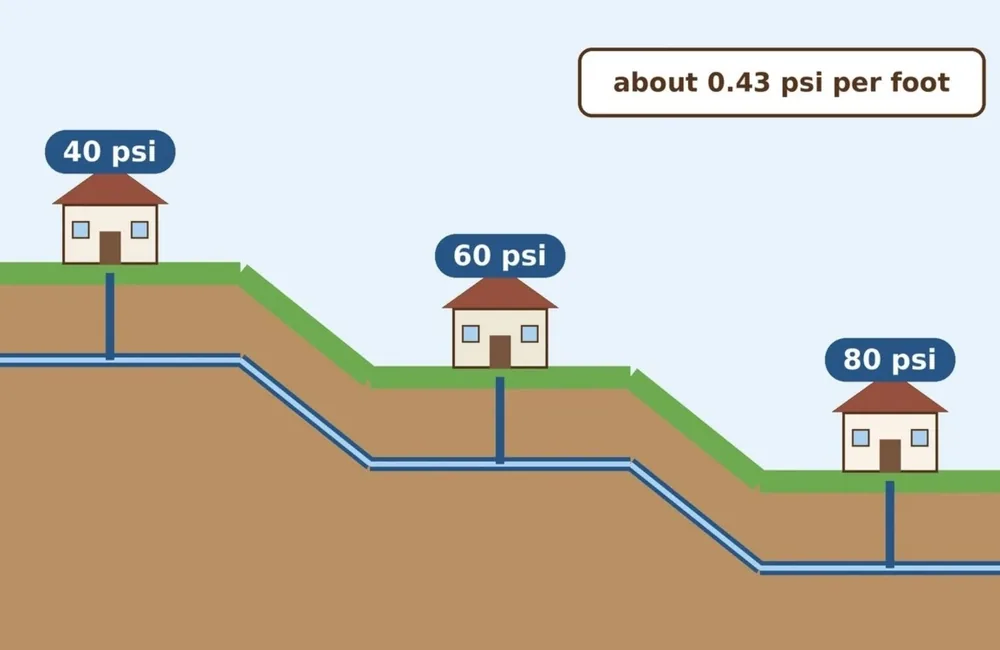
Gravity matters in a hilly area. Water pressure changes by about 0.43 pounds per square inch for each foot of elevation, so a house 100 feet below another on the same pressure zone can see around 43 psi more. Utilities divide systems into zones to manage this, but homes at the bottom of a zone still tend to see the highest pressure.
That is why the same city can have neighbors with very different complaints. The higher home may fight weak showers while the lower home fights banging pipes and a dripping relief valve.
Common Causes Of Low Pressure
A partly closed valve
The main shutoff or the meter valve may have been bumped or left partly shut after work.
Scale and corrosion
Mineral buildup and rust in older galvanized lines narrow the opening over the years.
A failing regulator
A worn pressure regulator can restrict flow and cause low or unsteady pressure.
A leak
A leak on the supply line steals pressure, and the meter test will show it.
What Your Gauge Reading Suggests
Treat these ranges as a guide and not a diagnosis. The plumbing code limit is the firm number.
| Reading | What it often means | What to do |
|---|---|---|
| Under about 30 psi | Low pressure, often noticeable at showers. | Check valves, aerators, the regulator, and for leaks. |
| About 40 to 60 psi | A comfortable range for many homes. | No action needed. |
| About 60 to 80 psi | Firm pressure, still within the code limit. | Watch for banging pipes and relief valve drips. |
| Above 80 psi | Over the plumbing code limit. | Have the regulator checked or installed. |
| Swings through the day | A supply or demand issue. | Take readings at several times and ask your provider. |
Pressure Reading Out Of Range?
Call and share the number from your gauge.
Fixing High Pressure
A pressure regulator, also called a pressure reducing valve, is a bell-shaped valve near the main shutoff. It lowers street pressure to a safe level for the house. Regulators wear out, and a failed one can let full street pressure through.
Replacing the regulator is usually a short job. If the home also has a closed system, a thermal expansion tank on the water heater gives heated water somewhere to go, which stops the relief valve from weeping. Both fixes follow the California Plumbing Code, which is based on the Uniform Plumbing Code (UPC).
After the work, retest with the gauge and write the new reading on the regulator with a marker, so you can spot drift next year. If the reading creeps up again within a season or two, the new regulator or a thermal expansion issue may need a second look from a technician.
What To Check Before You Call
Several low-pressure causes take minutes to rule out.
- Open the main shutoff and the meter valve fully. A partly closed valve is a surprisingly common cause.
- Unscrew the aerator on a weak faucet and rinse out the scale.
- Run the hot and cold taps separately. Weak hot water alone points to the water heater or its piping.
- Run the meter test to rule out a leak that is stealing pressure.
- Ask a neighbor if they see the same thing, which would point to a supply issue.
When Pressure Problems Point To Bigger Work
If the gauge shows adequate pressure at the bib but weak flow indoors, the restriction is inside the house. Corroded supply lines in older homes are a likely suspect, and supply line replacement may be worth pricing. If pressure drops between the meter and the house, water line repair and replacement addresses the buried line.
High pressure that has already damaged a pipe can end in a burst, in which case pipe burst repair comes first. On the slopes of Hacienda Heights, where lots sit at very different heights, a simple gauge reading explains many calls.
Water Pressure Questions
Many homes run comfortably between about 40 and 80 psi. The plumbing code calls for a regulator when street pressure exceeds 80 psi.
Check for a partly closed valve, a clogged aerator, a leak, or a failing regulator. A neighborhood supply issue is possible too, so ask your provider.
Water hammer happens when flowing water stops suddenly. High pressure, loose pipes, or no air chamber make it worse.
Yes. Excess pressure wears out faucets, supply lines, and appliance valves, and it can lead to leaks and bursts.
Regulators wear out with age and water quality. Check your pressure with a gauge once a year and replace the valve if readings drift.
Yes. Pressure changes about 0.43 psi per foot of elevation within a pressure zone, so hillside homes see very different numbers.